Spanish journalist and writer
Mostrando entradas con la etiqueta The Palestinian. Mostrar todas las entradas

jueves, 8 de diciembre de 2016

A Journalist Goes Undercover

Antonio Salas has gone undercover with multiple surgeries to change his look. He has transformed into a terrorist, sex trafficker, and hacker amongst other roles throughout his journalism career.         


Video: http://www.onenewspage.us/video/20161202/6172214/Journalist-Goes-Undercover.htm#

miércoles, 1 de junio de 2016

Dark Knights of The World

By Chaitra Somasundar, Staff Writer
The Dark Knight. James Bond. It makes me wonder about what real world heroes are like. Those who risk their own life every day to make the world a better place. Our world’s heroes – undercover agents. Being double-skinned is one of the hardest and dangerous jobs in the world. From exposing murders, trafficking and scandals to saving the world from terrorism and war, they risk their safety every day. Here is a list recognizing a few such heroes.
Antonio Mendez (photo courtesy of spymuseum.org)
Antonio Joseph “Tony” Mendez is a retired American CIA technical operations officer widely known for his management of the “Canadian Caper”. During a powerful revolution in Iran, students seized the U.S. Embassy in Tehran, taking up to 20 hostages for 444 days. When the American government failed to end the tensions between Iran and USA, Canada and the CIA launched a joint operation led by Tony Mendez to safely extricate the diplomats. They posed as a Canadian film crew as a part of their cover. In January of 1980, everyone involved successfully escaped Iran disguised as a movie production team.
Jack Garcia (photo courtesy of cal.morainepark.edu)
Jaoquin Garcia, a retired FBI agent is best known for his undercover work infiltrating the Gambino Crime Family (one of the “Five Families”) in New York. He penetrated the Gambino Family for about three years as “Jack Falcone,” a self proclaimed jewel thief and drug dealer. Gregory DePalma, a high ranking Gambino family capo even offered him the position of a “made man!” Jack led to 34 mobster arrests and convictions including the acting boss of the Mafia, Arnold Squiteiri. In 2008, Jack released a book called “Making Jack Falcone” giving details about some of his undercover cases and experiences with the FBI.
Dominic Proliferone (photo courtesy of cliffviewpilot.com)
Dominick Proliferone is the undercover cop who brought “The Iceman” to justice. Richard Kulinski was an American contract killer who claimed to have killed up to 250 people in his criminal career. He was given the name “The Iceman” for his method of freezing the victim to mask the time of death. An eighteen month long investigation was led by Dominick Proliferone who pretended to be a hitman to get close to Kulinski, and hired him for a fake murder. Polifrone recorded every conversation, and Kulinski was arrested not long after their exchange and charged with five counts of murder.
Carmelo Abbate (photo courtesy of snipview.com)
Carmelo Abbate is an Italian journalist and photographer. This undercover reporter posed as the boyfriend of one of the men in the inner circles of the Vatican’s priesthood! He exposed major escort servicing, child abuse, priests involved in pedophilia and sex rackets. He released videos, reports and even a book called “Sex and the Vatican: a secret journey in the reign of the chaste” which became a bestseller in France.
Antonio Salas (photo courtesy of yahoo.com)
Antonio Salas is the pseudonym of a Spanish journalist who is forced to keep his identity secret. He went undercover posing as Carlos’s webmaster (yes, Carlos, the Jackal, based on whom the Bourne Identity series was created). He has never been a part of any government organization and has lived for “a year as a Nazi skinhead, a year and half as a dealer of women, [and] six years as an international terrorist” to expose human trafficking, a terrorist legend and many other crimes. He has published multiple books such as Diary of a Skin, Operation Princess etc.
 

martes, 23 de febrero de 2016

10 Journalists Who Went Undercover Into Horrifying Situations

Journalists are often painted as people willing to do anything to get to the truth, and sometimes, that’s absolutely accurate. One of the most famous investigative journalists is Nellie Bly, who lived an incredible life. In addition to taking on Jules Verne’s “Around the World in 80 Days” challenge, she also had herself committed to an insane asylum for 10 days. The story of her work exposing the conditions at the Women’s Lunatic Asylum on Blackwell’s Island is one of the most famous cases of a journalist willing to do anything to get the story. However, she’s not the only one that’s gone to some pretty extreme lengths to expose the truth.
10 Walter Francis White
Southern US Racism
Born in Atlanta, Georgia, in 1893, Walter Francis White grew up as a witness to some horrible things. When he was 12 years old, he saw the unfolding of a race riot that engulfed the city, killing and injuring hundreds of people. The experience not only shaped his childhood, but his future career as a journalist. Light-skinned and blue-eyed, White was in a unique position. He could

pass as a white man, although he had been born into a black family—which was evident, when he, his parents, and his siblings were among those threatened during the 1906 riots.
Graduating from Atlanta University in 1916, White quickly became a member of the NAACP. By the next year, the acting secretary was traveling across the South, attending and investigating organized lynchings and race riots as a white man. From 1918–29, he went undercover at eight race riots and 41 lynchings, talking to those that were involved in starting the violence, gaining their trust—and their testimonies—which would then be published through the NAACP.
 
His reports were serialized in newspapers across the country, and his books debunked some of the major theories about hate crimes. One of the most often-repeated stories used to justify racial violence was the need to protect white women against sexual violence. White was not only able to show how untrue that was, but he was also able to provide the other side to the story, telling of the absolute terror and fear of physical violence that the South was living under.
 
White would go on to rise through the ranks of the NAACP. Even though he had a number of close calls in his undercover work, he went on to work alongside men serving on the front lines during World War II, reporting on the impact that race had on their treatment by their own country.
9 William Mueller, James Metcalfe And John Metcalfe
Nazi America
Before the beginning of World War II, there was a definite threat of the Nazi ideals taking root in countries outside of Germany. In the late 1930s, a group called the German American Bund was setting up shop in the United States. Over the course of a few years, the Bund gathered around 25,000 members under the leadership of Fritz Kuhn, who held the title “Bundesleiter.” In 1937, the Chicago Daily Times sent a few of its reporters undercover into the organization to see just what was going on there.
 
The Bund had all the anti-Semitic and pro-Nazi literature you could possibly imagine. They had their own elite guard, the Order Division, and they had a series of so-called training camps across New York and New Jersey. They held rallies, all with the goal of liberating America in the same way that Hitler was liberating Germany. After spending several weeks undercover in the organization, the reporters ran a massive expose that was about as well-received as you can probably imagine.
 
They reprinted parts of a Nazi primer, featuring such charming poetry as, “Hunch backs and crooked noses, / Disgusting creatures in their looks, / Their manners and their poses.” They talked about how the heads of the army had convinced their followers that they were ready and waiting for seize control of America for “white Americans,” published pictures of those smiling Americans delivering salutes to the Nazi ideals, and even ran a picture of the uncanny resemblance between Hitler and one of the undercover reporters, showing just how well they’d infiltrated the group.
 
The fallout was almost immediate, with thousands more people showing up to Bund rallies—but not in the spirit that the American Nazis had hoped for. Kuhn was run out of town again and again, his brave face failing miserably when the police attempting to protect him and keep the peace were overrun. Eventually, by 1939, Kuhn was in jail, found guilty of embezzlement.
8 Madeleine Doty
Women’s Prisons
On November 3, 1913, Maggie Martin was sent to the New York State Prison for Women at Auburn. Prisoner 933 wasn’t actually a prisoner, though; she was writer and reformer Madeleine Doty. In the book she wrote after her experience, Doty reflects on the knowledge that reformers like herself and her associates are helping to bring about a revolution in the way prisons are run and prisoners are treated. She needed to see firsthand, though, just what it was like being on the inside. She reflected that she was scared but excited, and that she wished that she looked stronger than she did, hoping that she wouldn’t be an easy target.
Doty’s reporting helped change the face of female prisoners. At the time, she feared for her safety from women that she believed were strong and rather masculine, the sort of people who still embodied a primitive type of humanity. The criminal theories of men like Cesare Lombroso were still in full swing, and ultimately, Doty would help turn those theories on their heads. The female offenders whom Doty was going to be living with were seen as irredeemable, and she would tell their stories.
She told of the mice and rats that they shared their cells with, the bad food, the straw pillows, and the work. She also talked about those she met, like Mary, the “jolly child of nature,” who was everyone’s friend and was constantly in trouble for defending others. She talked about patient, meek Christine, with a son born in prison and Harriet, the “Russian Jewess” with a fondness for Dante and Shakespeare. And she had her heart broken by the story of Rose, a mother at age 17 who was desperately in love with a married man and convicted of selling stolen goods. In the end, Doty’s works gave imprisoned women a face, experiences, personalities, and histories beyond what criminologists commonly reduced them to and began an era of reform—even though her undercover experiment was cut short by two days after she started to feel “on the verge of a breakdown.”
7 “Anna Erelle”
IS Recruitment
Journalists going undercover to expose something truly horrible might seem like it’s something of the past, but there are still some that will go to terrifying lengths for the truth. She only goes by the name “Anna Erelle” at the moment, because she’s afraid for her life.
The French journalist had been working on European jihadi extremists in the Islamic State for months, with a focus on what makes IS so attractive to a certain part of the young population. She wanted to know just how they were luring so many young women to their cause. After posing as a 20-year-old girl named “Melodie” on social networks, she made contact with a French jihadi called Abu Bilel.
The journalist progressed from Skyping briefly with him, to long talks, to eventually agreeing to run away from home and join him in Syria as one of his wives. Plans were made after months of conversations, and she was given instructions by which she (and another young friend) were to head to first Amsterdam, then to Istanbul, and then to a border city with Turkey. Plans changed; she was to be sent to Urfa . . . and she broke off contact.
Erelle made it as far as Amsterdam when the plans were changed, and she—and her editors—decided it was no longer worth the risk. Originally intending to make the trip with photographers instead of the young friend that she had originally said, Erelle released what information she had gotten on the recruitment process that the terrorist cells were using.
Her profile was immediately bombarded with threats and terrifying messages. She no longer uses her real name, lives in her own apartment, or keeps a phone number for very long. There are now videos of her online, along with judgments that Bilel and his associates have issued against her. Safety precautions haunt her everywhere now, and most likely always will.
6 W.T. Stead
Child Prostitution

W.T. Stead was a pretty strange spiritualist who claimed to be able to channel any number of spirits, but he was also a crusading journalist who did some pretty incredible things when it came to exposing the realities of child slavery and prostitution.
Stead partnered with the Salvation Army in a sting operation in London in the 1880s. For five days, London papers ran the ongoing story of his experiences posing as a well-off gentleman hanging out on Charles Street who was looking to purchase a young girl for his very own. Approaching a brothel owner on the guidance of a member of Parliament, Stead requested to take delivery of a couple of girls who were accompanied by a doctor’s certificate authenticating their virginity. The brothel owner agreed and went in search of some suitable girls whose parents were willing to sell.
Stead ultimately bought a 13-year-old girl named “Lily” for £5 total. The mother, who had been rather desperate to sell her, would get £3 when her daughter was delivered to Stead and the rest when a doctor had verified that she was still a virgin. Stead described the young girl as industrious and intelligent, able to read and write, and a loving child who didn’t deserve the drunken mother who was willing to sell her for some quick cash. He also uncovered a corrupt group of midwives and doctors who would attest to the child’s virginity. In addition to the certificate, they would sell the buyer a phial of chloroform as well as reassurances that they would help the child afterward if it was needed.
London was outraged, and Stead went to jail—not for purchasing a 13-year-old girl, but because he had only gotten her mother’s permission to buy her and not her father’s. Stead continued to write and edit the paper from his jail cell. In the end, he succeeded in getting laws regarding the age of consent changed, and he also spearheaded reforms that made legislation against prostitution more strict.
5 Frank Smith
Mental Hospitals


Nellie Bly wasn’t the only undercover reporter to bravely head into the notoriously bad conditions of an insane asylum. In 1935, a Chicago Daily Times reporter named Frank Smith spent a week in the Kankakee State Hospital for the Insane. Supposedly committed by his brother, Smith was actually entered into the system by another reporter from the Times posing as a family member. He described it as seven days of Hell.
When Smith published his 10-part expose, one of the first things he mentions is the dirty, contaminated water and the communal drinking cup. A single cup was shared by all patients, both those who are physically healthy and those who are suffering from the common illness—syphilis. Part of the reason for his commitment was his supposed issues with violence, and he wrote that while he was less than thrilled about being sent into the hospital in the first place, it soon became clear just how bad of a week he was about to have when he spent 15 hours strapped down in a bathtub full of dirty river water as a supposed cure for his violent tendencies. He also talked about the fire-trap halls, something that hadn’t changed since a fire in 1885 that cost 17 patients their lives.
When he checked himself out (he was admitted as a voluntary patient), he found his bottle of whiskey missing out of his things when they were returned to him. He hoped he would never see the inside of the prison again. Shockingly, though, it wasn’t until the 1960s that things began to change at the hospital, and the last of the mentally ill patients weren’t moved out until 1974.
4 Carmelo Abbate
Hypocrisy In The Vatican
The Vatican and the Catholic Church are still one of the most powerful organizations in the world, and going up against their teachings and their doctrines can be a pretty intimidating thing, especially if you go about it like Carmelo Abbate did.

In 2010, the Italian journalist went undercover among the inner circles of the Vatican’s priesthood, posing as the boyfriend of one of the men, who was already involved in the private parties and the escort services run throughout Rome. When Abbate released his findings—including a book and videos that he’d taken of three of the Roman priests—he made it clear that he wasn’t targeting them because they were gay; he was targeting them because they were hypocrites. He’s also quick to separate his work from the other major sex scandal within the Church—child abuse.
 
While undercover, Abbate got a firsthand look at just how heavily the escort services in Rome depend on priests for their success and trade. The problem he has is with the difference between the treatment of straight and gay priests. Technically, since they’re all supposed to be celibate, it shouldn’t even matter. He found, however, that it does.
 
The Catholic Church fired back, trying to play the “offensive stereotype” card. However, the Vatican has remained pretty silent on the whole thing, while Abbate says that the extreme hypocrisy and double standards need to be stopped. Some are going as far as using his findings to point out that the Church is focused more strictly on the orientation of their clergy members rather than the deviance they’ve unfortunately become known for.
3 George Morrison
Blackbirding
Blackbirding is the name of a shady program for recruiting people to become indentured servants. Throughout the 1890s and up until around World War I, groups of ships would go island-hopping throughout the Pacific. Recruits would be picked up and signed to contracts, where they would agree to go work on plantations for a certain amount of time. That was the theory, at least, but it was absolutely up for debate on how well these contracts were explained, how willing recruits were, and whether or not it was just a fancy way of collecting more slaves.
In 1882, George Morrison was a medical student in need of a break from school. Wanting to get an intimate look at the so-called blackbirding process and the labor trade, he signed on as a seaman and doctor’s assistant on a ship called the Lavinia. His original story read more like a travel blog than an expose of any real note, but it inspired him to turn from medical school to journalism.
His follow-up painted blackbirding as the weakly disguised slave trade that many had always thought it to be. He described the intimidation techniques that were used to get people to sign on, such as holding people at gunpoint until they agreed to their contracts, the poor health conditions, the lack of sanitation onboard the ship, and the treatment of women, calling some of the ships little more than brothels. Further questioning the legality of the practice, he pointed out that the people often in charge of things like health regulations and approvals were the ones that owned the ships, making it less than likely that they were being very honest.
His condemnation got the attention of various government officials, who either supported him or condemned him, depending largely on whether or not it was in their best financial interests to do so. It wasn’t until Britain got involved that there was at least the establishment of a regulatory committee in the form of deputy commissioners, backed by an increased number of naval vessels.
2 Marvel Cooke
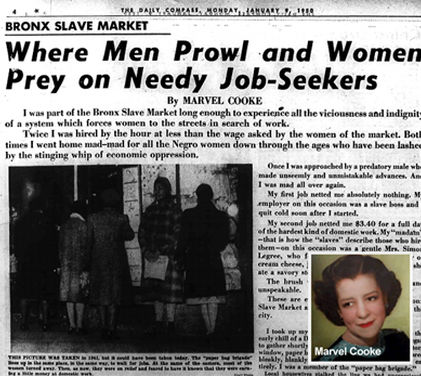
The Bronx Slave Market
Marvel Cooke was born in Minnesota in 1903, and by the 1950s, she was living in New York City and working for The Daily Compass. It was there that she wrote The Bronx Slave Market, an expose on the practices of upper-class women who would hire day laborers for a pittance, as well as the difficulties that the laborers would face day after day.
Cooke joined the women she saw standing on the street corner every day. They would line the streets, hoping to appeal to someone looking for a housekeeper. When Cooke joined them, she was hired by an elderly woman at a rate of $0.80 an hour, while the going rate established by the Domestic Workers Union was $1 an hour.

Her first experience was one she’d heard about: The slave market employers would claim that the work that was done was so subpar that they would refuse to pay—no matter how well they’d actually done the job. Some, she was warned, would pay them less or turn the clocks back to make them work longer. She also got a firsthand look at the men that would prey on the women looking for work. The unmistakably straightforward, lewd advances made the degrading search for work even worse.
 
After an entire day of dusting, laundry, being ordered around, and scrubbing floors on her hands and knees, Cooke had her story: The slave trade was alive and well, thriving on the streets of New York. Part of the solution wasn’t just the organization of a Domestic Workers Union but more locations and a wider opportunity for women to join it and be protected by it. Cooke’s undercover work exposed the life of a group of women too afraid to join the protection of a union for fear of the benefits they relied on being taken away. She ultimately pushed ahead legislation to protect domestic workers, education, and the establishment of accessible unionization.
 
1 Antonio Salas
Extremist Terrorism
“Antonio Salas” (a pseudonym) has successfully taken undercover, investigative journalism to the extreme. He’s gone undercover to expose child trafficking rings and into the world of the skinhead supporters of the Real Madrid football league, and he’s most recently gone undercover as a radical Islamist after the 2004 bombings in Madrid.
 
After learning Arabic, getting a circumcision, and writing his own copy of the Quran by hand, he wrote a couple of books to give himself credibility and invented an incredibly tragic backstory about the death of his pregnant wife. Eventually, he would make contact with—and become a trusted ally of—one of the terrorist world’s most notorious assassins, a man named Carlos the Jackal.
 
He met the Jackal’s brothers and family and eventually became his confidant, friend, and webmaster. The website had been put together in hopes of raising support to have the Jackal returned to Venezuela, and while Antonio was running it, he taped his frequent conversations with the Jackal along with what turned out to be murder confessions. He took training courses in how to be a terrorist, and the Jackal occasionally called him from jail, just to make sure he was safe.
 
And, incredibly, he did it all without the backing of any sort of government intelligence agency, police security, or even official media credentials. Traveling is limited sometimes, as he has to do it under his real name and with his real passport. He says that his family has been under police protection since his time undercover in the human trafficking ring, and most of his friends aren’t even aware of the double life he’s living.

He talks about friends who sit and discuss the books, movies, and exposes of the investigative journalist Antonio Salas, having no idea that they’re talking to him.

And as for the danger he puts himself in all the time? He says, “My conscience is clear, and even if they catch me, I’ll go having made sure I’ve lived my life to the fullest. I learned all I could and tried to do something useful.”


Journalist Antonio Salas on “How is a Terrorist Made?”

Antonio Salas has immersed himself as an under-cover investigative reporter many times. For six years, he trained to adopt the identity of “Muhammad Abdallah,” a Venezuelan man of Palestinian origin. During this time, Salas learned written and spoken Arabic. He studied the Quran, and memorized fragments of it which he wrote out in traditional calligraphy. He also underwent a circumcision and skin-darkening treatments, and grew a long beard. He gave up pork, smoking, and drinking. He took classes alongside anti-terrorist specialists and policemen.
To test his new identity as “Muhammad Abdallah,” he traveled to Morocco, Jordan, Israel, and Palestine. In Ramallah, he learned the psychology of terrorists: the trauma and frustration many face, which is, in turn, harnessed by extremists.
Then, in 2006, he set off for Venezuela because, as he says in the video, “the place in the world where a terrorist can be born was Venezuela.”
His intention was to find out — how is a terrorist made? (My question to Salas is — what is his motivation as an investigative reporter?)
In Venezuela, he found the presence of ETA, FARC, Colombian paramilitary groups, Hamas, Al Qaeda, and clumps of Venezuela’s Bolivarian groups whose members converted to Islam.
The result is a book and the video, embedded below, which was filmed while under-cover using a tiny hidden camera.


lunes, 18 de mayo de 2015

Journalist Antonio Salas on “How is a Terrorist Made?”

 
Antonio Salas has immersed himself as an under-cover investigative reporter many times. For six years, he trained to adopt the identity of “Muhammad Abdallah,” a Venezuelan man of Palestinian origin. During this time, Salas learned written and spoken Arabic. He studied the Quran, and memorized fragments of it which he wrote out in traditional calligraphy. He also underwent a circumcision and skin-darkening treatments, and grew a long beard. He gave up pork, smoking, and drinking. He took classes alongside anti-terrorist specialists and policemen.
To test his new identity as “Muhammad Abdallah,” he traveled to Morocco, Jordan, Israel, and Palestine. In Ramallah, he learned the psychology of terrorists: the trauma and frustration many face, which is, in turn, harnessed by extremists.
Then, in 2006, he set off for Venezuela because, as he says in the video, “the place in the world where a terrorist can be born was Venezuela.”
His intention was to find out — how is a terrorist made? (My question to Salas is — what is his motivation as an investigative reporter?)
In Venezuela, he found the presence of ETA, FARC, Colombian paramilitary groups, Hamas, Al Qaeda, and clumps of Venezuela’s Bolivarian groups whose members converted to Islam.
The result is a book and the video, embedded below, which was filmed while under-cover using a tiny hidden camera.
** WARNING: VERY GRAPHIC IMAGES ** 


martes, 10 de febrero de 2015

Antonio Salas and the 10 Most Courageous Undercover Journalists


Sometimes, getting the scoop on a story means doing more than simple research and interviews. Sometimes it requires a bigger and riskier sacrifice, like going undercover. Although the ethics and credibility of undercover tactics have been called into question, in some cases, the only way to unearth the truth is to go incognito.
Fabricated identities, hidden cameras, and gruesome and terrifying revelations are just a few of the aspects involved in this insider method of getting the story. And it’s hard not to admire these gutsy journalists’ passion and dedication to their careers, as they infiltrate everything from psychiatric hospitals and federal penitentiaries to jihadist terrorist groups and soccer hooligan gangs. This is definitely a career path for those seeking thrills, excitement, and danger.
 

10. Elizabeth Jane Cochrane "Nellie Bly"
Elizabeth Jane Cochrane, also known by her pen name Nellie Bly, was one of the first female reporters in the US. However, when she was pressed into writing about what were deemed appropriate topics for women reporters, such as gardening and fashion, Cochrane moved from Pittsburgh to New York in 1887. There, an editor at the New York World dubiously offered her an undercover assignment that required both courage and daring. Cochrane was to act insane, get committed to a lunatic asylum, and report on the conditions inside.
Few women of the day would have dreamed of doing such a thing, but Cochrane did, despite her editor’s admission that he didn’t know exactly how he would get her out again. Cochrane feigned madness and amnesia, and she was soon admitted to the Blackwell Island Lunatic Asylum. She spent 10 days enduring abusive mistreatment from nurses, disgusting rat-infected conditions, dirty drinking water, and spoiled food. Released upon request of The World, Cochrane wrote an exposé about her experiences that led to more thorough examinations in insanity cases and an $850,000 increase in budget for the Department of Charities and Collections.

9. Chris Terrill
Chris Terrill is a British anthropologist and documentary filmmaker who has covered everything from school bullying to the British Royal Navy tracking cocaine smugglers in the Caribbean. Terrill has developed his own “lone-wolf” style, in which he fulfills all the roles of production – from filming and directing to presenting.
 In 1992, Terrill disguised himself as a wildlife smuggler in order to investigate the major gangs involved in the illegal orangutan trade. He has also gone undercover posing as a trader of women to expose human trafficking gangs operating in Denmark, Belgium, and the Dominican Republic. The work of infiltrating and exposing the activities of such groups makes Terrill’s career choice seem a noble and courageous calling.

8. Peter Warren

Born in London, Peter Warren has worked as a journalist and private investigator in Canada for over 50 years. He was a talk-show host for 35 of those years and has taken a special interest in cold cases and wrongful convictions. His undercover work has ranged from spending four days locked up as a patient in a psychiatric ward, to pretending to be a would-be investor.
His most gutsy stint, however, may well have been spending an entire week as a convict in Stony Mountain Penitentiary in Manitoba. Warren wanted to bring more attention to the case of David Milgaard, a man wrongfully convicted of raping and murdering a nursing assistant named Gail Miller. Warren interviewed Milgaard many times about his plight. Finally, in 1997, Milgaard’s innocence was proven and he was released. He’d already spent 23 years in prison.

7. Anas Aremeyaw Anas
Ghanaian investigative reporter Anas Aremeyaw Anas – who does not show his face in public and uses his anonymity to his advantage – has gone undercover dozens of times in his native city of Accra. From the beginning, Anas, who started out with a clear career path as a student reporter, wanted to begin exposing corruption. And he was soon in charge of investigative journalism at Ghanaian newspaper The Crusading Guide, which he now co-owns as The New Crusading Guide. Way to climb the career ladder.
Anas has posed as a janitor in a brothel to expose child prostitution, pretended to be an assembly-line worker at a cookie factory (where maggot-infested flour was being used), and even checked into a psychiatric ward as a patient. While there, he caught one of the orderlies selling drugs (and recorded himself buying them), saw unfed patients eating from dumpsters, and documented how a corpse was left for days in a ditch until it was taken away in a van used to transport food.
Anas’s goal is to make sure his government does something about corruption and crimes by providing it with evidence.

6. John Howard Griffin

In 1959, white novelist John Howard Griffin began taking the drug Oxsoralen, which, in combination with sunlamp exposure, turned his skin black. No other alteration to his appearance was necessary, apart from shaving his head. He had become, to all eyes, a black man. Essentially, he had changed race for his career.
Griffin traveled through the Deep South of the United States with the aim of discovering what it was like to be black. A Texan by birth, he had been taught by society that black people were different and inferior. A variety of experiences – ranging from smuggling Jews to safety with the French Resistance, to suffering from years of blindness after being struck by shrapnel in WWII – had a profound effect on him. What’s more, Griffin began to question whether racism was merely a “Southern problem,” or if it was, as he had come to believe, a “human problem.”
For a month, Griffin got a close-up look at how black people were treated. He called it “a dirty bath” of hatred. His book, Black Like Me, documented his journey and saw him receive death threats from some of his fellow white men. He was even hanged in effigy.

5. Stuart Goldman

Stuart Goldman is an American reporter who became known as “the journalistic hitman” for an acid-tongued column he wrote for the Los Angeles Times. His undercover work includes investigating TV evangelist Terry Cole-Whittaker and even infiltrating a UFO cult. In the ‘90s, Goldman went undercover to expose tabloid media, both print and television, as a criminal organization. For three years, he used the alias Will Runyon and gathered information as a “mole.” At the end of his investigation, he claimed that the tabloids had an extensive spy-network, including doctors and bodyguards, who would report on celebrity movements. Reporters would sift through celebrity trash looking for “prescriptions, early pregnancy tests, [and] letters.”
 The tabloids, Goldman reported, even hired private investigators to find unlisted phone numbers. They would call the number, pretending to be someone else, and glean information that way. In 1998, he published his findings in a book, titled Snitch: Confessions of a Tabloid Spy. There must be plenty of people in Goldman’s profession who don’t like him very much. That sort of dedication to your work takes guts.

4. Donal MacIntyre

Commenting on his 20-year career, Irish investigative journalist Donal MacIntyre says, “I’ve been shot at, beaten, abused on the streets in front of my children and forced to move house more than 50 times because of death threats.”
During his career, MacIntyre has gone incognito repeatedly and in various different situations. He has assumed roles in environments ranging from the adventure sports industry to care homes for vulnerable people – where he exposed conditions that led to one institution closing and two individuals being cautioned for assault.
However, one of MacIntyre’s best-known and bravest undercover exploits happened in 1999, when he posed as a prospective member of the Chelsea Headhunters, a notorious gang of football hooligans. During his time undercover, MacIntyre confirmed that the Headhunters had ties to the neo-Nazi organization Combat 18. Several gang members were arrested and convicted as a result of the investigation, and one member, Jason Marriner, was handed a six-year jail sentence for organizing a clash with rival fans. MacIntyre was placed under police protection during the trial.

3. Günter Wallraff
German writer Günter Wallraff is a master of disguise. Using assumed identities to disarm his targets, he has, through his work, provided a unique form of social commentary – from the inside. In 1969, Wallraff began his undercover career with 13 Undesired Reports, which chronicle his experiences posing as an alcoholic, a vagabond, and a chemical factory worker.
 
Later, in 1974, he headed to Greece, then under control of the Ioannides military dictatorship, for perhaps his most dangerous exploit. Wallraff protested in Athens’s Syntagma Square, chaining himself to a post to protest human rights violations. And, because he intentionally didn’t carry any form of ID, he was arrested, beaten and tortured. Even when his identity was disclosed, Wallraff was imprisoned – and only released later that year when the dictatorship collapsed.
 Incredibly, in 2007, aged 64, Wallraff went undercover in a German call center. And in 2009, like John Howard Griffin before him (see entry 6), he posed as a black man to expose racial prejudice, a move that drew controversy.
In Wallraff’s honor, Swedish dictionary Svenska Akademiens Ordlista has included the word ‘walraffa,’ which means, “to expose misconduct from the inside by assuming a role.”
 
2. Tim Lopes

Brazilian journalist Tim Lopes grew up in a Rio de Janeiro favela (slum), and it was most likely this background that furnished him with his “old-school” technique of working the streets for stories. Lopes proceeded to go undercover in the favelas to film illegal activities with a hidden camera. These were dangerous and often neglected areas where the city government had no control. Instead, criminal gangs and drug lords ruled.
In 2001, Lopes helped collect undercover footage showing drug dealers and traffickers openly patrolling the streets with AK-47s. The report resulted in the police taking action and, ultimately, a decrease in revenue for the drug lords. Lopes gained a reputation for this kind of work, and on June 2, 2002, drug traffickers kidnapped him. Lopes was beaten, brutally tortured, set on fire, and murdered. In the end, he gave his life for his career.

1. Antonio Salas
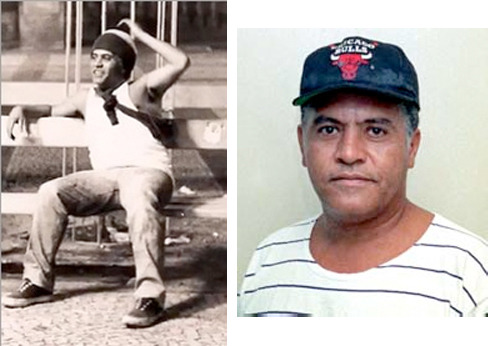
Antonio Salas, an investigative journalist known only by his pseudonym, has made undercover work a way of life. In his own words, he has lived for “a year as a Nazi skinhead, a year and half as a dealer of women, [and] six years as an international terrorist.” Yet while this dangerous career has required incredible bravery and sacrifice, it has also scarred the man. Salas says that the terrible things he has seen undercover give him nightmares.
Showing his dedication, to prepare for his infiltration of a jihadist terror group, Salas fabricated an elaborate cover story, handwrote a personal copy of the Quran, and even got circumcised when he was invited to a bathhouse.
Incredibly, Salas also worked closely with infamous Venezuelan terrorist Carlos the Jackal, running a website for him. Salas dedicates himself to his work in order to tell the public what’s really happening. And one encouraging result has been the letters he’s received from people who have seen the error of their ways and chosen to change.
“From a very early age I thought that doctor or teacher are the two best professions you can have,” says Salas, describing his chosen career. “But I am very rebel and undisciplined for both works. So I ended up choosing the third option: journalist. Investigate what the power is trying to hide, and tell the world is also a good way of feeling useful.”

by Yvonne McArthur